Aperçu des sections
-

-
Dear students! For your Civilization module, your first-semester oral evaluation will be a 4–5 minute video explaining only a part of a lesson from this semester. You don’t need to show your face—just focus on your explanation. The video will be graded out of 20. Please submit it by December 1st, 2025; late submissions won’t be accepted. Good luck, and do your best! You email it or upload it here:
https://docs.google.com/forms/d/e/1FAIpQLSf-IVYEVHdazG2zXHADQcbdr1HTACD_kOED-EO9H7Wssi1G3g/viewform?usp=dialog
-
Dear students,
This is to inform you that the first-semester second interrogation will take place according to the schedule below.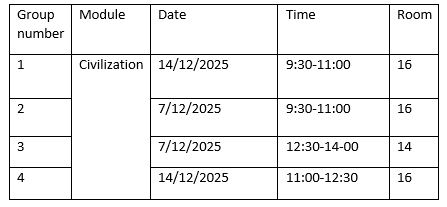
-
-

Institute of Letters and Languages
Department of Foreign Langauges
Teacher: Dr. Khelifa Chelihi Rania
Contact: k.rania@centre-univ-mila.dz
Target audience: Second Year students of English
Teaching Unit: Discovery
Module: British Culture and Civilization
Credits: 04
Coefficient: 02
-
1. Identify and explain the major historical and intellectual movements that shaped Britain from the Age of Reason to Imperialism.
2. Analyze the social, economic, and cultural transformations brought by the Industrial Revolution and the Victorian Age.
3. Evaluate the moral values, reforms, and ideologies associated with Victorianism and Chartism.
4. Examine the causes, motives, and consequences of British imperial expansion in India.
5. Apply critical thinking to interpret how these periods collectively influenced modern British society, culture, and identity.
-
- Basic knowledge of European and British history, particularly from the Renaissance to the early modern period.
- Familiarity with key literary and cultural movements in Britain.
- Ability to read, understand, and analyze academic texts in English.
- Foundational skills in writing short analytical or reflective paragraphs in English.
- General awareness of social, political, and economic concepts such as revolution, reform, and empire.
- Motivation to engage in
discussion, critical thinking, and independent learning.

-
Lecture 1: Age of Reason
Lecture 2: The Industrial Revolution
Lecture 3: The Victorian Age
Lecture 4: Victorianism
Lecture 5: British Imperialism in India -
- Simon Schama, A History of Britain: At the Edge of the World, 3500 BC – 1603 AD (2000)
- Peter Salway, Roman Britain: a very short introduction (Oxford UP, 2015).
- Copeland, Tim (2014). Life in a Roman Legionary Fortress. Amberley Publishing Limited. p. 14.

- Gerald Harriss, Shaping the Nation: England 1360-1461 (New Oxford History of England) (2005).
- J. Steven Watson, The Reign of George III, 1760-1815 (Oxford History of England) (1960) online free to borrow.
- Gerard O'Brien, "The Grattan Mystique." Eighteenth-Century Ireland/Iris an dá chultúr(1986): 177-194 online.
- Patrick M. Geoghegan, The Irish Act of Union: a study in high politics, 1798-1801 (Gill & Macmillan, 1999).
- J. M. Thompson, Napoleon Bonaparte: His rise and fall (1951) pp 235-40
- R.E. Foster, Wellington and Waterloo: The Duke, the Battle and Posterity 1815-2015(2014)
- Jeremy Black, The War of 1812 in the Age of Napoleon (2009)
- E.L. Woodward, The Age Of Reform 1815-1870 (1938) online free
- Boyd Hilton, A Mad, Bad, and Dangerous People?: England 1783-1846 (New Oxford History of England, 2008).
- Kenneth Baker, "George IV: a Sketch," History Today 2005 55(10): 30–36.
- Brock, Michael "William IV (1765–1837)", Oxford Dictionary of National Biography, (2004) doi:10.1093/ref:odnb/29451
- Jeremy Black, A military history of Britain: from 1775 to the present (2008), pp. 74–77