I.2 – Ecosystems: Classification and Characteristics
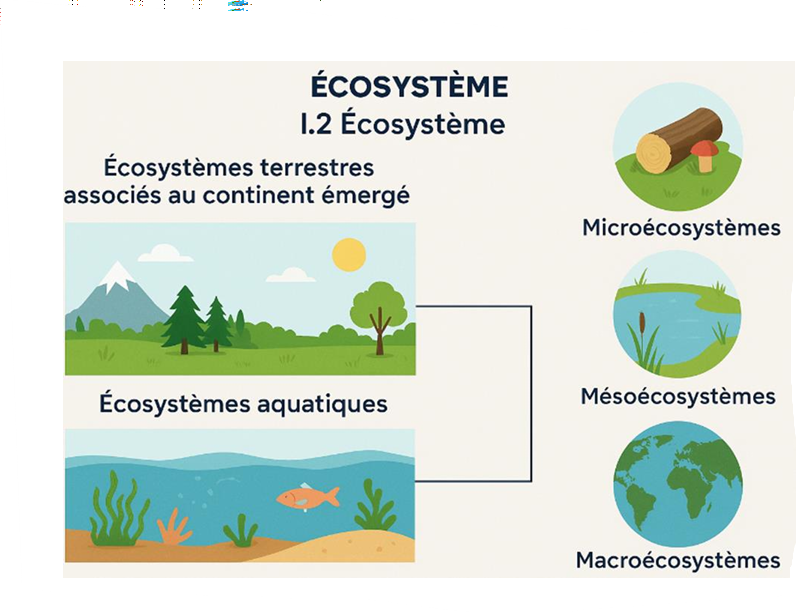
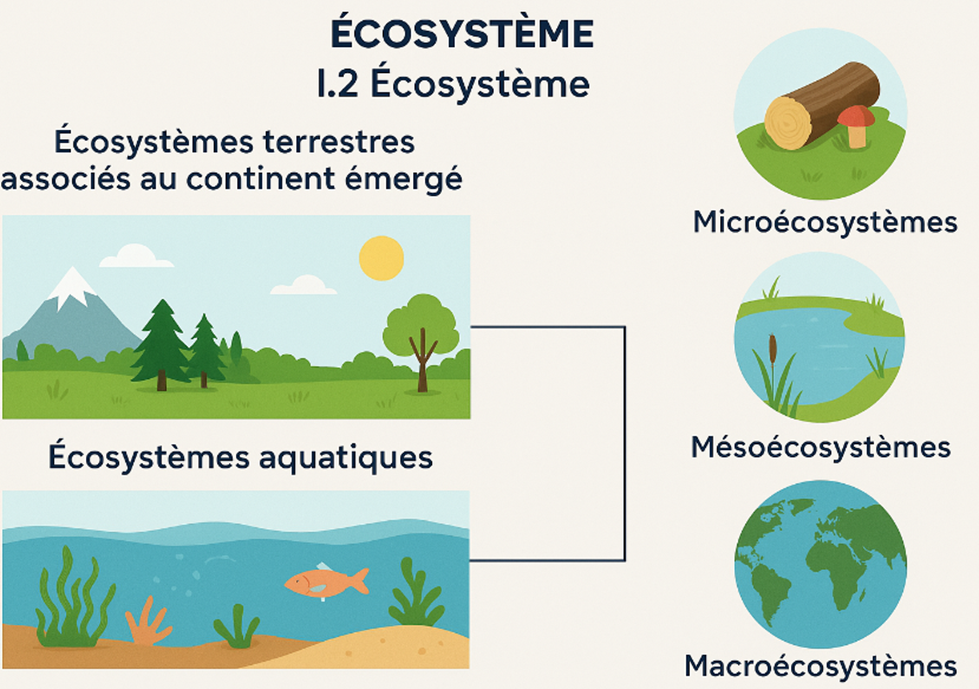
1. Terrestrial Ecosystems Associated with Emerged Continents Terrestrial ecosystems develop on continental surfaces and are influenced by climatic, geological, and biological factors.
Characteristics:
- Tropical Forests: Extreme biodiversity, high temperature, and humidity (e.g., Amazon Rainforest).
- Deserts: Low precipitation, vegetation adapted to drought (e.g., Sahara Desert).
- Grasslands and Savannas: Dominated by grasses, marked dry and wet seasons (e.g., Serengeti).
- Tundra: Polar climate, frozen soil (permafrost), low vegetation (e.g., Siberia).
- Mountains: Altitudinal zonation with variations in temperature and pressure (e.g., Alps).
Key Components:
- Biotic: Plants, animals, microorganisms.
- Abiotic: Soil, temperature, light, precipitation.
2. Aquatic Ecosystems Aquatic ecosystems include freshwater and marine environments, structured by depth, salinity, and currents.
Types:
- Freshwater:
- Lentic(still waters: lakes, ponds).
- Lotic (flowing waters: rivers, streams).
- Marine: - Coastal Zones(mangroves, coral reefs).
- Pelagic (open waters, plankton).
- Abyssal (dark depths, bioluminescent organisms).
Biological Adaptations:
- Organisms with gill respiration (fish).
- Floating plants (water lilies) or fixed plants (algae).
3. Microecosystems Small-scale ecosystems where biotic and abiotic interactions are localized.
Examples:
- A puddle of water: Insect larvae, algae, bacteria.
- A dead tree trunk: Fungi, beetles, worms.
- The gut microbiome: Bacteria, archaea, yeasts.
Importance:
- Maintenance of biodiversity on a small scale.
- Natural laboratories for studying ecological interactions.
4. Mesoecosystems Intermediate-scale ecosystems often corresponding to specific landscapes or habitats.
Examples:
- A temperate forest: Trophic networks including herbivores, carnivores, and decomposers.
- A lake: Littoral zones, pelagic zones, and deep zones with distinct communities.
- An agricultural field: Interactions between crops, pollinators, and pests. Functions:
- Regulation of biogeochemical cycles (C, N, P).
- Support for ecosystem services (pollination, water purification). 5. Macroecosystems Large-scale ecosystems at the planetary or regional level encompassing entire biomes. Examples: -
Biosphere: Interaction between all Earth's ecosystems.
- Biomes:
- Boreal Forest(taiga).
- Indian Ocean (tropical marine ecosystems).
- Great Grasslands (steppes). Challenges: - Climate change and melting polar ice caps.
- Deforestation and biodiversity loss. Synthesis and Interactions
- Ecological Hierarchy: Microecosystems integrate into mesoecosystems and then into macroecosystems.
- Resilience: Disturbances (fires, pollution) affect each scale differently.
- Conservation:Protecting ecological corridors to maintain connectivity between ecosystems.
Applications:
- Sustainable resource management (fishing, agriculture).
- Ecological restoration (species reintroduction, reforestation).
I.3 Plant Responses to Environmental Factors
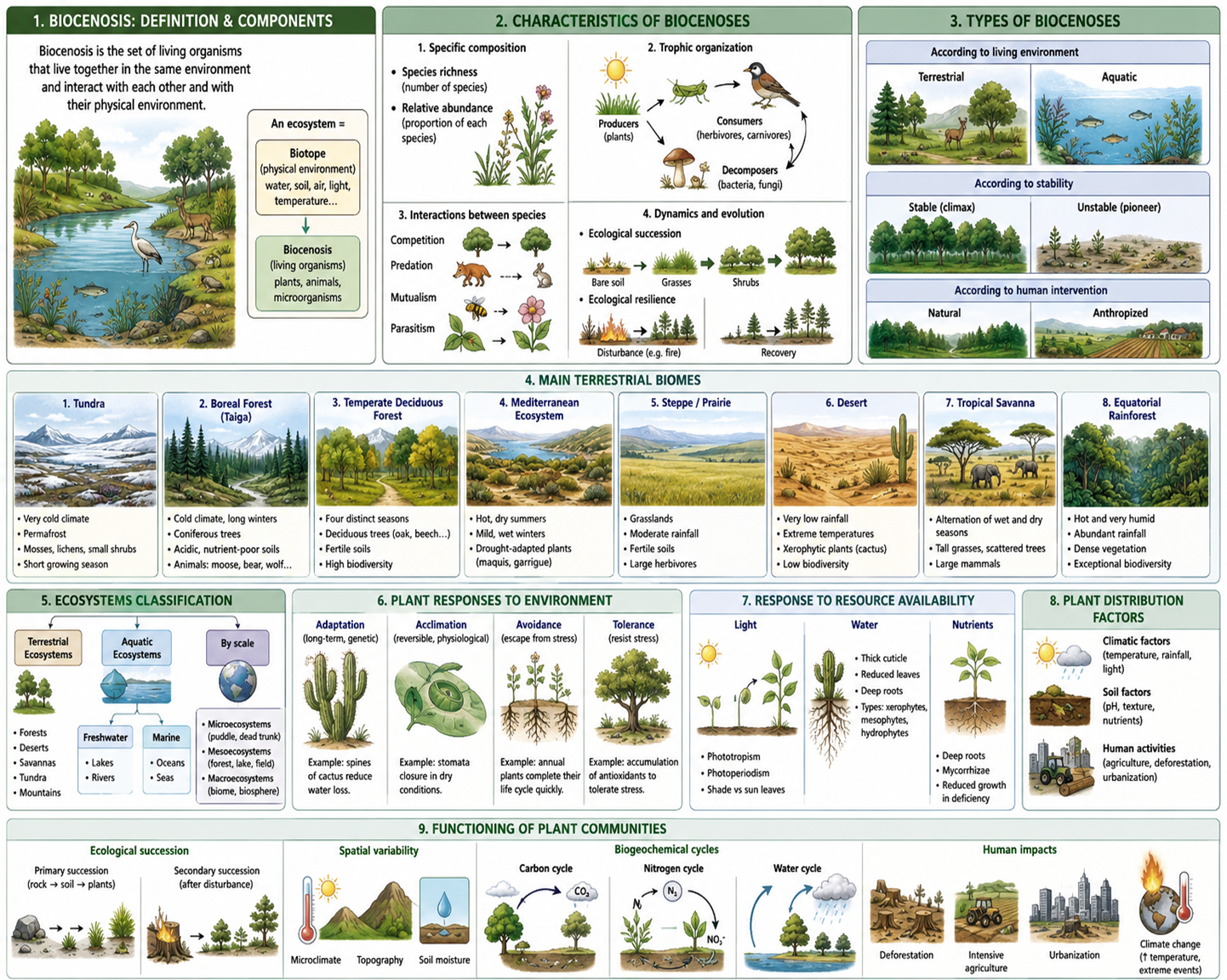
1. General Response Mechanisms Plants, as sessile (fixed) organisms, cannot escape unfavorable environmental conditions. Therefore, they have developed physiological, morphological, and behavioral adaptation mechanisms to respond to various environmental factors, including:
1. Adaptation
➤ Definition: Adaptation is a stable and hereditary genetic modification of a plant species that enables it to survive in a given environment. It results from natural selection over long periods of time.
➤ Characteristics: Hereditary: Passed on to future generations. Long-term: Part of the evolutionary process. Leads to the emergence of ecotypes or specialized species.
➤ Examples: Desert cacti have developed thick stems to store water and spines instead of leaves to reduce evaporation. Alpine plants have rosette-shaped, often hairy leaves to conserve heat and protect against wind.
2. Acclimation
➤ Definition: Acclimation is a reversible and non-hereditary physiological response to an environmental change. It allows the plant to quickly adjust to a change, but it is not passed on to offspring.
➤ Characteristics: Short to medium term (from days to seasons). Depends on the adaptive potential of the species. Helps maintain optimal physiological function.
➤ Examples: A plant exposed to more light may produce more photosynthetic pigments (chlorophyll, carotenoids). During temporary drought, some plants close their stomata to reduce water loss (a reversible mechanism).
3. Avoidance
➤ Definition: Avoidance is a set of strategies that allow a plant to reduce or bypass exposure to stress without directly resisting it. ➤ Types: Morphological avoidance: Structural changes. Phenological avoidance: Adjustment of the life cycle.
➤ Examples: Closing stomata during the hottest hours of the day (to avoid excessive transpiration). Desert annuals: rapid germination and short life cycle limited to the rainy season (avoiding summer drought). Vertically oriented leaves to avoid maximum sun exposure.
4. Tolerance
➤ Definition: Tolerance is the plant's ability to maintain vital functions even under intense or prolonged stress.
➤ Growth reduction in case of deficiencies.
4. Plant Distribution The distribution of plant species depends on: Climatic conditions: Temperature, rainfall, sunlight. Soil characteristics: pH, texture, nutrient content. Human activities: Agriculture, deforestation, urbanization. This distribution creates biogeographical zones and biomes where only specifically adapted species can survive.
I.4 Functioning of Plant Communities 1. Spatio-temporal Variations in Plant Communities Plant communities evolve over time (ecological succession) and across space (zonation, gradients). a. Ecological Succession: Primary: On virgin substrates (lava, dunes). Secondary: After disturbances (fire, abandoned farmland). Leads to climax communities: Stable ecosystems. b. Spatial Variability: Depends on microclimates, topography, soil moisture. Zonation in mountains, forests, wetlands, etc.
2. Functioning of Communities and Biogeochemical Cycles Plant communities play a key role in major natural cycles: a. Carbon Cycle: Photosynthesis → CO₂ storage → Primary productivity. Crucial role in climate regulation. b. Nitrogen Cycle: Nitrogen fixation by legumes. Nitrate absorption by plants, return through decomposition. c. Water Cycle: Transpiration and evapotranspiration. Important for regulating soil and atmospheric moisture.
3. Human Impact on Vegetative Cover Functioning Human activities drastically alter plant ecosystems: Deforestation: Loss of biodiversity, changes in local climate. Intensive agriculture: Soil depletion, pollution from fertilizers. Urbanization: Fragmentation of natural habitats. Climate change: Shift in species distribution ranges, water stress. Consequences: Decline in ecosystem services (carbon storage, water filtration). Loss of ecological resilience. Need for sustainable management and ecological restoration.
✅ Conclusion Studying how plants respond to environmental factors helps us understand their distribution, adaptation, and vulnerability to change. The functioning of plant communities is closely tied to natural cycles, biodiversity, and ecological balance. Understanding these interactions is essential for ecosystem conservation and sustainable development.