
Aperçu des sections
chapitre 1
Le Processus Entrepreneurial
Le processus entrepreneurial est un enchaînement de phases par lesquelles un entrepreneur passe pour créer et développer une entreprise.
1.1. Identification de l’opportunité
L'entrepreneur doit :
- Observer le marché pour repérer des besoins non satisfaits.
- Analyser les tendances économiques et technologiques.
- Évaluer ses compétences et ses ressources pour exploiter une opportunité.
1.2. Étude de faisabilité et planification
Une fois l'opportunité identifiée, il est essentiel d'évaluer sa viabilité :
- Étude de marché : Analyse des clients potentiels, de la concurrence et du positionnement.
- Modèle économique (business model) : Définition de la source de revenus et de la structure des coûts.
- Plan d’affaires (business plan) : Document détaillant les objectifs, la stratégie, les prévisions financières et les besoins en financement.
1.3. Mobilisation des ressources
L'entrepreneur doit réunir les ressources humaines, financières et matérielles nécessaires :
- Le capital financier : Fonds propres, prêts bancaires, investisseurs, aides publiques.
- Les ressources humaines : Équipe, partenaires, sous-traitants.
- Les outils et infrastructures : Local, matériel, technologies.
1.4. Création et lancement de l’entreprise
- Choisir la forme juridique de l'entreprise (SARL, SAS, auto-entreprise…).
- Enregistrer l’entreprise auprès des autorités compétentes.
- Mettre en place une stratégie de marketing et de communication.
- Lancer la production et la commercialisation des produits/services.
1.5. Gestion et développement de l’entreprise
- Suivi des performances : Indicateurs de performance clés (KPI).
- Adaptation aux évolutions du marché : Innovation et amélioration continue.
- Expansion : Diversification des produits, internationalisation, partenariats stratégiques.
Culture d’Entreprise et Culture Entrepreneuriale
2.1. Définition de la culture d’entreprise
La culture d’entreprise est l’ensemble des valeurs, des croyances et des pratiques qui caractérisent une organisation. Elle influence la manière dont les employés interagissent et prennent des décisions.
Éléments clés de la culture d’entreprise :
- Valeurs et vision : Mission et objectifs de l’entreprise.
- Normes et comportements : Style de management, relations internes.
- Identité visuelle : Logo, communication, image de marque.
2.2. Définition de la culture entrepreneuriale
La culture entrepreneuriale repose sur des attitudes et des comportements favorisant l’initiative et l’innovation.
Caractéristiques principales :
- Esprit d’initiative et autonomie.
- Créativité et innovation.
- Prise de risque et résilience face aux échecs.
- Orientation vers les opportunités et la croissance.
2.3. Différences entre culture d’entreprise et culture entrepreneuriale
2.4. Influence de la culture entrepreneuriale sur la réussite des entreprises
- Favorise la capacité d’adaptation aux changements du marché.
- Encourage la prise d’initiative et l’innovation.
- Contribue à une meilleure gestion des crises.
L’Importance de l’Entrepreneuriat
L’entrepreneuriat joue un rôle clé dans le développement économique et social.
3.1. Création de richesse et d’emplois
- Génération de revenus pour les entrepreneurs et leurs employés.
- Réduction du chômage grâce à la création de nouvelles entreprises.
3.2. Innovation et compétitivité
- Développement de nouvelles technologies et services.
- Stimulation de la concurrence et amélioration des produits existants.
3.3. Impact social et développement durable
- Amélioration des conditions de vie en proposant des solutions adaptées aux besoins locaux.
- Promotion de l’entrepreneuriat social pour résoudre des problématiques sociétales et environnementales.
3.4. Contribution à la diversification économique
- Réduction de la dépendance à un secteur unique (exemple : passage d’une économie basée sur les hydrocarbures à une économie diversifiée).
- Encouragement à l’autonomie financière et à l’esprit d’entreprise.
The Entrepreneurial Process
The entrepreneurial process is a sequence of stages that an entrepreneur goes through to create and develop a business.
1.1. Opportunity Identification
The entrepreneur must:
-
Observe the market to identify unmet needs.
-
Analyze economic and technological trends.
-
Assess their skills and resources to exploit an opportunity.
1.2. Feasibility Study and Planning
Once the opportunity is identified, it is essential to assess its viability:
-
Market study: Analysis of potential customers, competition, and market positioning.
-
Business model: Definition of revenue sources and cost structure.
-
Business plan: A document detailing objectives, strategy, financial forecasts, and funding requirements.
1.3. Resource Mobilization
The entrepreneur must gather the necessary human, financial, and material resources:
-
Financial capital: Personal funds, bank loans, investors, public subsidies.
-
Human resources: Team members, partners, subcontractors.
-
Tools and infrastructure: Premises, equipment, technologies.
1.4. Business Creation and Launch
-
Choose the legal form of the business (LLC, joint-stock company, sole proprietorship, etc.).
-
Register the business with the relevant authorities.
-
Implement a marketing and communication strategy.
-
Launch the production and commercialization of products/services.
1.5. Business Management and Development
-
Performance monitoring: Key Performance Indicators (KPIs).
-
Adaptation to market changes: Innovation and continuous improvement.
-
Expansion: Product diversification, internationalization, strategic partnerships.
Corporate Culture and Entrepreneurial Culture
2.1. Definition of Corporate Culture
Corporate culture refers to the set of values, beliefs, and practices that characterize an organization. It influences how employees interact and make decisions.
Key elements of corporate culture:
-
Values and vision: Company mission and objectives.
-
Norms and behaviors: Management style, internal relationships.
-
Visual identity: Logo, communication, brand image.
2.2. Definition of Entrepreneurial Culture
Entrepreneurial culture is based on attitudes and behaviors that encourage initiative and innovation.
Main characteristics:
-
Initiative and autonomy.
-
Creativity and innovation.
-
Risk-taking and resilience in the face of failure.
-
Opportunity- and growth-oriented mindset.
2.3. Differences Between Corporate Culture and Entrepreneurial Culture
Criteria Corporate Culture Entrepreneurial Culture Definition Set of shared values, norms, and practices within a company that influence its operations and decisions. Mindset that promotes innovation, initiative, and value creation within an organization or project. Main objective Ensure internal cohesion, stability, and long-term performance. Encourage innovation, autonomy, and risk-taking to create and develop new opportunities. Approach to risk Cautious, risk management to ensure business sustainability. Risk tolerance, experimentation, and acceptance of failure as a learning source. Innovation Gradual and controlled innovation within internal processes. Strong innovation capacity and continuous search for new opportunities. Structure Hierarchical and well-defined with clear roles. Flexible and adaptable, encouraging versatility and responsiveness. Employee autonomy Compliance with established rules, limited autonomy depending on structure. High autonomy, initiative-taking encouraged. Example of application Well-established companies with strong values and traditions (e.g., large industrial firms, banks). Startups, incubators, fast-growing companies, and innovative projects. In summary, corporate culture focuses on management and stability, while entrepreneurial culture is based on innovation and individual initiative.
2.4. Influence of Entrepreneurial Culture on Business Success
-
Enhances adaptability to market changes.
-
Encourages initiative-taking and innovation.
-
Contributes to better crisis management.
The Importance of Entrepreneurship
Entrepreneurship plays a key role in economic and social development.
3.1. Wealth and Job Creation
-
Generation of income for entrepreneurs and their employees.
-
Reduction of unemployment through the creation of new businesses.
3.2. Innovation and Competitiveness
-
Development of new technologies and services.
-
Stimulation of competition and improvement of existing products.
3.3. Social Impact and Sustainable Development
-
Improvement of living conditions by offering solutions tailored to local needs.
-
Promotion of social entrepreneurship to address social and environmental challenges.
3.4. Contribution to Economic Diversification
-
Reduction of dependence on a single sector (e.g., transition from a hydrocarbon-based economy to a diversified economy).
-
Encouragement of financial independence and entrepreneurial spirit.
Section 2
Définition de l’entrepreneur
L’entrepreneur est une personne qui identifie une opportunité économique, mobilise les ressources nécessaires (humaines, financières, matérielles) et prend des risques pour créer, développer ou reprendre une activité économique, souvent sous forme d’entreprise.
🔍 Selon Joseph Schumpeter : l’entrepreneur est celui qui innove, qui introduit de nouveaux produits, processus ou marchés.
🔍 Selon Peter Drucker : « L’entrepreneuriat consiste à rechercher le changement, y répondre et exploiter cela comme une opportunité ».
Rôles principaux de l’entrepreneur :
-
Créer de la valeur
-
Innover
-
Prendre des risques
-
Mobiliser les ressources
-
Créer des emplois
L’évolution du concept d’entrepreneur
L'idée de l'entrepreneur a évolué au fil des siècles :
Période Conception de l’entrepreneur XVIIIe siècle L’entrepreneur est un commerçant ou artisan qui gère sa propre activité. XIXe siècle Il devient un industriel, souvent capitaliste, qui prend des risques économiques. XXe siècle L'entrepreneur est perçu comme un innovateur (Schumpeter) et un moteur de développement. XXIe siècle L’entrepreneur est un leader, innovateur, porteur de solutions durables et technologiques. ✅ L’entrepreneuriat est aujourd’hui lié à l’innovation sociale, environnementale et numérique.
Les caractéristiques individuelles de l’entrepreneur
L'entrepreneur possède des qualités et compétences spécifiques qui lui permettent de réussir son projet :
🔹 Caractéristiques personnelles
-
Autonomie et sens des responsabilités
-
Confiance en soi
-
Esprit d’initiative
-
Créativité et capacité à innover
-
Résistance au stress et persévérance
🔹 Compétences professionnelles
-
Maîtrise du domaine d’activité
-
Compétences en gestion et en planification
-
Leadership et communication
-
Capacité d’analyse des risques
🔹 Motivations courantes
-
Réalisation personnelle
-
Indépendance financière
-
Goût du défi
-
Désir de changer le monde (impact social)
Profil de l’entrepreneur algérien
Contexte général :
L’entrepreneuriat en Algérie connaît une dynamique croissante, notamment chez les jeunes, soutenue par des dispositifs comme l’ANSEJ (ex-Angem, ANADE), les incubateurs universitaires, les fonds d’investissement ou encore les concours de startups.
Profil type de l’entrepreneur algérien :
Critère Description Âge Majoritairement entre 25 et 40 ans Niveau de formation Diplômé universitaire ou ayant suivi une formation technique Secteurs privilégiés Agriculture, TIC, commerce, services, industrie légère Motivations Autonomie financière, absence d’emploi salarié, valorisation des compétences Contraintes Accès limité au financement, bureaucratie, manque d’accompagnement Points forts Capacité d’adaptation, esprit d’innovation, volonté de contribuer à l’économie L’entrepreneur est un acteur clé du développement économique et social. Son rôle ne se limite pas à la création d’entreprise, mais s’étend à l’innovation, à la transformation sociétale et à la création d’emplois. En Algérie, malgré les défis, l'entrepreneuriat est en pleine expansion, porté par une jeunesse motivée, de plus en plus formée, et des politiques publiques en évolution.
-
Section 3
La Démarche Entrepreneuriale et la Création d'une Start-up en Algérie3. La démarche Entrepreneuriale La démarche entrepreneuriale est un processus structuré qui transforme une idée en une réalité économique (entreprise). Elle implique plusieurs étapes logiques, chacune étant essentielle pour la réussite du projet.3.1 De l’idée à l’opportunité L’idée est souvent la première étincelle : elle peut naître d’une passion, d’une expérience personnelle, d’une observation d’un problème non résolu, etc.Transformer une idée en opportunité nécessite :Évaluer la faisabilité technique et économique.Vérifier qu’il existe une demande réelle sur le marché.S'assurer que le projet est innovant ou qu’il propose une valeur ajoutée.Outils utiles : Brainstorming, SWOT (forces, faiblesses, opportunités, menaces), Canvas Business Model. Exemple : Une idée d'application mobile pour faciliter la commande de produits locaux devient une opportunité si elle répond à un besoin mal couvert.3.2 L’innovation L’innovation est la capacité d'introduire quelque chose de nouveau ou d’amélioré. Elle peut concerner :Le produit (nouvelle fonctionnalité).Le processus (nouvelle méthode de fabrication).Le modèle économique (nouvelle façon de vendre).En Algérie, l’innovation est un critère important pour les start-ups, soutenue notamment par le Ministère de l’Économie de la Connaissance.Astuce : Protéger son innovation avec un brevet, un dépôt de marque ou un modèle enregistré.3.3 L’analyse du marché Analyser le marché consiste à comprendre l’environnement dans lequel l'entreprise évoluera :Étudier la demande : Qui sont les clients ? Quels sont leurs besoins ?Analyser l’offre : Qui sont les concurrents ? Quelles sont leurs forces/faiblesses ?Identifier les tendances : Quelles évolutions sociales, technologiques, économiques ou politiques influencent le marché ?Techniques utilisées : Enquêtes, entretiens, questionnaires.Études documentaires (rapports, statistiques, études sectorielles).Objectif : Définir un positionnement clair et un avantage concurrentiel.3.4 Le Plan d’affaire (Business Plan) Le Business Plan est un document clé qui présente :Le projet (idée, mission, vision).L'étude de marché et le positionnement.Le modèle économique (comment générer des revenus).La stratégie de développement (marketing, production, RH).Le plan financier (investissements, prévisions de chiffre d’affaires, de rentabilité).Le montage juridique (forme de l'entreprise : SARL, SPA, etc.)Pourquoi est-il essentiel ? Convaincre les investisseurs, banques ou organismes de soutien.Guider les actions de l’entrepreneur.3.5 Le Financement Créer une entreprise nécessite souvent des ressources financières :Sources de financement : Apport personnel (capital de départ).Famille, amis (love money). Banques (prêts bancaires classiques ou islamiques).Programmes de soutien algériens (ANSEJ, ANGEM, CNAC).Business Angels ou fonds de capital-risque.Subventions et concours pour start-ups innovantes.Important : Avoir un plan de trésorerie réaliste pour éviter les crises de liquidité.3.6 Les Partenaires : Les partenaires sont essentiels pour renforcer la crédibilité et la capacité opérationnelle : Partenaires commerciaux (fournisseurs, distributeurs).Partenaires financiers (banques, investisseurs).Partenaires technologiques (laboratoires, universités, centres de recherche).Institutions d'accompagnement (incubateurs, accélérateurs, chambres de commerce).Bénéfices d'un bon partenariat : Mutualiser les ressources.Accélérer l’accès au marché.Partager les risques.4. Étapes administratives de création d'une entreprise en Algérie Créer une start-up en Algérie suit un processus administratif spécifique.Voici les étapes principales :4.1 Choisir la forme juridique Entreprise individuelle (personne physique).Société (personne morale) : EURL (Entreprise Unipersonnelle à Responsabilité Limitée).SARL (Société à Responsabilité Limitée).SPA (Société par Actions).Start-up labellisée (label Start-up délivré par le Ministère de l'Économie de la Connaissance).Remarque : Pour obtenir des avantages spécifiques aux start-ups (exonérations fiscales, accompagnement), il faut demander le Label Start-up.4.2 Réserver le nom commercial Se rendre au Centre National du Registre du Commerce (CNRC).Vérifier la disponibilité du nom.Réserver le nom commercial en ligne via le site sidjilcom.cnrc.dz.4.3 Rédiger les statuts Établir les statuts juridiques de l’entreprise (définition de l’objet social, répartition du capital, responsabilités des associés).4.4 Enregistrement et immatriculation Déposer un dossier complet auprès du CNRC :Statuts signés.Copie de la carte d'identité nationale.Certificat de résidence.Justificatif d'adresse du siège social (bail, titre de propriété).Paiement des frais d'enregistrement.Délai moyen : 1 à 2 semaines.4.5 Obtention du NIS, NIF et carte fiscale NIS :Numéro d'Identification Statistique. NIF : Numéro d'Identification Fiscale.Carte fiscale délivrée par la Direction des Impôts.4.6 Affiliation aux organismes sociaux S’inscrire à :CASNOS (Caisse Nationale de Sécurité Sociale des Non-Salariés) pour l’entrepreneur individuel.CNAS (Caisse Nationale des Assurances Sociales) pour les salariés éventuels.4.7 Demander le Label Start-up (facultatif mais conseillé) Déposer la demande sur la plateforme officielle startup.dz.Conditions : Projet innovant.Moins de 7 ans d’existence.Chiffre d'affaires annuel plafonné.Éligibilité aux avantages fiscaux et au fonds Algérien d’investissement pour Start-ups (Algerian Startup Fund).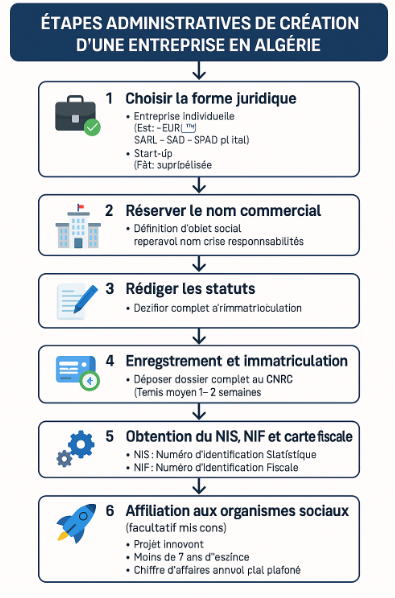 Conclusion La démarche entrepreneuriale est un cheminement logique, partant d’une idée pour aboutir à la création d’une entreprise structurée et performante. En Algérie, des facilités administratives et des dispositifs de soutien ont été mis en place pour encourager les jeunes entrepreneurs, notamment dans les secteurs innovants.
Course: Entrepreneurship 2025/2026

Learning Objectives
• Prepare for professional integration at the end of studies through both individual and collective development.
• Develop a post-bachelor's project, whether pursuing further studies or seeking employment.
• Master the methodological tools needed to define a post-bachelor's career plan.
• Prepare for the job search process.
• Raise awareness of entrepreneurship by providing an overview of management knowledge useful for creating a business. Recommended Prerequisites
• Basic knowledge and language skills.
Course Content
1. Introduction to Entrepreneurship
• Definition of entrepreneurship
• Diversity of entrepreneurial situations
• Different forms of entrepreneurship
• The entrepreneurial process
• Corporate culture and entrepreneurial culture
• The importance of entrepreneurship
2. The Entrepreneur
• Definition of the entrepreneur
• Evolution of the concept of entrepreneurship
• Individual characteristics of the entrepreneur
• Profile of the Algerian entrepreneur
3. The Entrepreneurial Approach
• From idea to opportunity
• Innovation
• Market analysis
• Business plan
• Financing
• Partners
4. Administrative Steps for Business Creation in Algeria
• How to create a startup in AlgeriaCHAPTER 1
1. The Entrepreneurial Process
The entrepreneurial process consists of a sequence of stages through which an entrepreneur goes to create and develop a business.
1.1. Opportunity Identification
The entrepreneur must:
- Observe the market to identify unmet needs.
- Analyze economic and technological trends.
- Assess their skills and resources to exploit an opportunity.
1.2. Feasibility Study and Planning
Once the opportunity is identified, its viability must be evaluated through:
- Market study: Analysis of potential customers, competitors, and market positioning.
- Business model: Definition of revenue sources and cost structure.
- Business plan: A detailed document outlining objectives, strategy, financial forecasts, and funding needs.
1.3. Resource Mobilization
The entrepreneur must gather the necessary human, financial, and material resources:
- Financial capital: Personal funds, bank loans, investors, and public support.
- Human resources: Team members, partners, and subcontractors.
- Tools and infrastructure: Premises, equipment, and technology.
1.4. Business Creation and Launch
- Choose the legal structure of the business (LLC, corporation, sole proprietorship, etc.).
- Register the company with the relevant authorities.
- Implement a marketing and communication strategy.
- Launch the production and commercialization of products or services.
1.5. Business Management and Growth
- Performance monitoring through Key Performance Indicators (KPIs).
- Adaptation to market changes through innovation and continuous improvement.
- Expansion through product diversification, internationalization, and strategic partnerships.
CHAPTER 2
1. Corporate Culture and Entrepreneurial Culture
1.1. Corporate Culture
Corporate culture is the set of values, beliefs, and practices that characterize an organization. It influences how employees interact and make decisions.
Key elements of corporate culture:
- Values and vision: The company's mission and objectives.
- Norms and behaviors: Management style and internal relationships.
- Visual identity: Logo, communication, and brand image.
1.2. Entrepreneurial Culture
Entrepreneurial culture is based on attitudes and behaviors that encourage initiative and innovation.
Main characteristics:
- Initiative and autonomy
- Creativity and innovation
- Risk-taking and resilience in the face of failure
- Opportunity and growth orientation
1.3. Differences Between Corporate Culture and Entrepreneurial Culture
Criteria
Corporate Culture
Entrepreneurial Culture
Definition
A set of shared values, norms, and practices within a company that influence its operations and decisions.
A mindset that promotes innovation, initiative, and value creation within an organization or project.
Main Objective
Ensure internal cohesion, stability, and long-term performance.
Encourage innovation, autonomy, and risk-taking to create and develop new opportunities.
Approach to Risk
Cautious, with risk management aimed at ensuring business sustainability.
Risk-tolerant, emphasizing experimentation and viewing failure as a learning opportunity.
Innovation
Gradual and structured innovation within internal processes.
Strong focus on innovation and the constant search for new opportunities.
Structure
Hierarchical and well-defined, with clear roles and responsibilities.
Flexible and adaptable, encouraging versatility and responsiveness.
Employee Autonomy
Employees follow established rules; autonomy may be limited depending on the structure.
Autonomy is encouraged, and initiative is highly valued.
Example
A well-established company with strong values and traditions, such as large industrial firms or banks.
A startup or innovative company focused on rapid growth and market disruption.
In summary, corporate culture focuses on management and stability, while entrepreneurial culture is based on innovation and individual initiative.
2.4. The Influence of Entrepreneurial Culture on Business Success
- Enhances the ability to adapt to market changes.
- Encourages initiative and innovation.
- Improves crisis management.
CHAPTER 3
1. The Importance of Entrepreneurship
Entrepreneurship plays a key role in economic and social development.
3.1. Wealth Creation and Employment
- Generates income for entrepreneurs and their employees.
- Reduces unemployment through the creation of new businesses.
3.2. Innovation and Competitiveness
- Promotes the development of new technologies and services.
- Stimulates competition and improves existing products.
3.3. Social Impact and Sustainable Development
- Improves living conditions by offering solutions tailored to local needs.
- Supports social entrepreneurship to address social and environmental challenges.
3.4. Contribution to Economic Diversification
- Reduces dependence on a single sector, such as hydrocarbons.
- Encourages financial independence and entrepreneurial spirit.
Definition of the Entrepreneur
An entrepreneur is a person who identifies an economic opportunity, mobilizes the necessary resources (human, financial, and material), and takes risks to create, develop, or acquire a business.
- According to Joseph Schumpeter, an entrepreneur is someone who innovates by introducing new products, processes, or markets.
- According to Peter Drucker, "Entrepreneurship is about searching for change, responding to it, and exploiting it as an opportunity."
Main Roles of an Entrepreneur
- Creating value
- Innovating
- Taking risks
- Mobilizing resources
- Creating jobs
The Evolution of the Entrepreneur Concept
The concept of the entrepreneur has evolved significantly over the centuries.
Period
Concept of the Entrepreneur
18th Century
The entrepreneur was viewed as a merchant or craftsman managing his own business.
19th Century
The entrepreneur became an industrialist, often a capitalist, willing to take economic risks.
20th Century
The entrepreneur was seen as an innovator and a driving force of economic development, particularly through the work of Joseph Schumpeter.
21st Century
The entrepreneur is regarded as a leader, innovator, and provider of sustainable and technological solutions.
Entrepreneurship today is closely linked to social, environmental, and digital innovation.
Individual Characteristics of an Entrepreneur
An entrepreneur possesses specific qualities and skills that enable them to successfully carry out their projects.
Personal Characteristics
- Autonomy and a strong sense of responsibility
- Self-confidence
- Initiative
- Creativity and innovation
- Stress resistance and perseverance
Professional Skills
- Mastery of their field of activity
- Management and planning skills
- Leadership and communication abilities
- Risk analysis and decision-making skills
Common Motivations
- Personal fulfillment
- Financial independence
- Love of challenges
- Desire to make a positive impact on society
Profile of the Algerian Entrepreneur
General Context
Entrepreneurship in Algeria is experiencing significant growth, particularly among young people. This development is supported by various initiatives, including government programs, university incubators, investment funds, and startup competitions.
Typical Profile of an Algerian Entrepreneur
- Generally young, often between 25 and 40 years old
- University graduate or professionally trained
- Strong interest in innovation and digital technologies
- Motivated by financial independence and professional achievement
- Increasingly oriented toward solving local economic and social challenges
- Adaptable and resilient in the face of administrative and financial constraints
The Algerian entrepreneur is becoming a key driver of economic diversification and sustainable development in the country.
Criterion
Description
Age
Generally between 25 and 40 years old.
Education Level
University graduate or holder of a technical qualification.
Preferred Sectors
Agriculture, Information and Communication Technologies (ICT), trade, services, and light industry.
Motivations
Financial independence, limited salaried employment opportunities, and the desire to make the most of one's skills.
Challenges
Limited access to financing, bureaucratic procedures, and insufficient support or mentoring.
Strengths
Adaptability, innovative mindset, and a strong commitment to contributing to economic development.
The Entrepreneur as a Key Actor in Economic and Social Development
· The entrepreneur is a key actor in economic and social development. Their role is not limited to creating businesses, but also extends to innovation, social transformation, and job creation. In Algeria, despite challenges, entrepreneurship is rapidly growing, driven by motivated youth, increasing levels of education, and evolving public policies.
Entrepreneurial Process and Start-up Creation in Algeria
3. The Entrepreneurial Process
· The entrepreneurial process is a structured approach that transforms an idea into an economic reality (a business). It involves several logical steps, each essential for project success.
3.1 From Idea to Opportunity
· An idea is often the first spark; it may come from passion, personal experience, or the observation of an unsolved problem.
· Transforming an idea into an opportunity requires:
- Evaluating technical and economic feasibility.
- Ensuring there is real market demand.
- Confirming that the project is innovative or provides added value.
· Useful tools:
- Brainstorming
- SWOT analysis (Strengths, Weaknesses, Opportunities, Threats)
- Business Model Canvas
· Example: An idea for a mobile app to facilitate ordering local products becomes an opportunity if it meets an unmet market need.
3.2 Innovation
· Innovation is the ability to introduce something new or improved. It may concern:
- The product (new features)
- The process (new production method)
- The business model (new way of selling)
· In Algeria, innovation is an important criterion for start-ups, supported by the Ministry of the Knowledge Economy.
· Tip: Protect innovation through patents, trademarks, or registered designs.
3.3 Market Analysis
· Market analysis involves understanding the environment in which the business will operate:
- Demand analysis: Who are the customers? What are their needs?
- Supply analysis: Who are the competitors? What are their strengths and weaknesses?
- Trend analysis: What social, technological, economic, or political factors influence the market?
· Methods used:
- Surveys, interviews, questionnaires
- Documentary research (reports, statistics, sector studies)
· Objective: Define a clear positioning and competitive advantage.
3.4 Business Plan
· The business plan is a key document that presents:
- The project (idea, mission, vision)
- Market study and positioning
- Business model (how revenue will be generated)
- Development strategy (marketing, production, HR)
- Financial plan (investment, revenue and profitability forecasts)
- Legal structure (SARL, SPA, etc.)
· Why is it essential?
- To attract investors, banks, or support institutions
- To guide the entrepreneur’s actions
3.5 Financing
· Creating a business often requires financial resources.
· Funding sources include:
- Personal contribution (starting capital)
- Family and friends (“love money”)
- Banks (conventional or Islamic loans)
- Algerian support programs (ANSEJ, ANGEM, CNAC)
- Business angels and venture capital funds
- Grants and startup competitions
· Important: A realistic cash flow plan is necessary to avoid liquidity problems.
3.6 Partners
· Partners are essential to strengthen credibility and operational capacity:
- Commercial partners (suppliers, distributors)
- Financial partners (banks, investors)
- Technological partners (laboratories, universities, research centers)
- Support institutions (incubators, accelerators, chambers of commerce)
· Benefits of partnerships:
- Resource sharing
- Faster market access
- Risk sharing
CHAPTER 4
. Administrative Steps for Creating a Business in Algeria
· Creating a start-up in Algeria follows a specific administrative process.
4.1 Choosing the Legal Structure
- Sole proprietorship (individual business)
- Companies:
- EURL (Single Member Limited Liability Company)
- SARL (Limited Liability Company)
- SPA (Joint Stock Company)
- Certified Start-up (start-up label issued by the Ministry of Knowledge Economy)
· Note: To benefit from start-up advantages (tax exemptions, support), obtaining the Start-up Label is required.
4.2 Reserving the Business Name
- Visit the National Trade Register Center (CNRC)
- Check name availability
- Reserve the business name online via: sidjilcom.cnrc.dz
4.3 Drafting the Articles of Association
· Prepare the legal statutes of the company (business purpose, capital distribution, partners’ responsibilities).
4.4 Registration and Incorporation
· Submit a complete file to the CNRC including:
- Signed statutes
- National ID copy
- Residence certificate
- Proof of business address (lease or property document)
- Payment of registration fees
· Processing time: 1 to 2 weeks
4.5 Obtaining NIS, NIF, and Tax Card
- NIS: Statistical Identification Number
- NIF: Tax Identification Number
- Tax card issued by tax authorities
4.6 Social Security Registration
- CASNOS: National Social Security Fund for non-salaried workers
- CNAS: National Social Insurance Fund for employees
4.7 Applying for Start-up Label (optional but recommended)
· Apply via the official platform: startup.dz
· Conditions:
- Innovative project
- Less than 7 years of existence
- Limited annual turnover
· Benefits:
- Tax advantages
- Access to the Algerian Startup Investment Fund
Conclusion
The entrepreneurial process is a logical pathway that starts from an idea and leads to the creation of a structured and successful business. In Algeria, administrative facilitations and support mechanisms have been introduced to encourage young entrepreneurs, especially in innovative sectors.
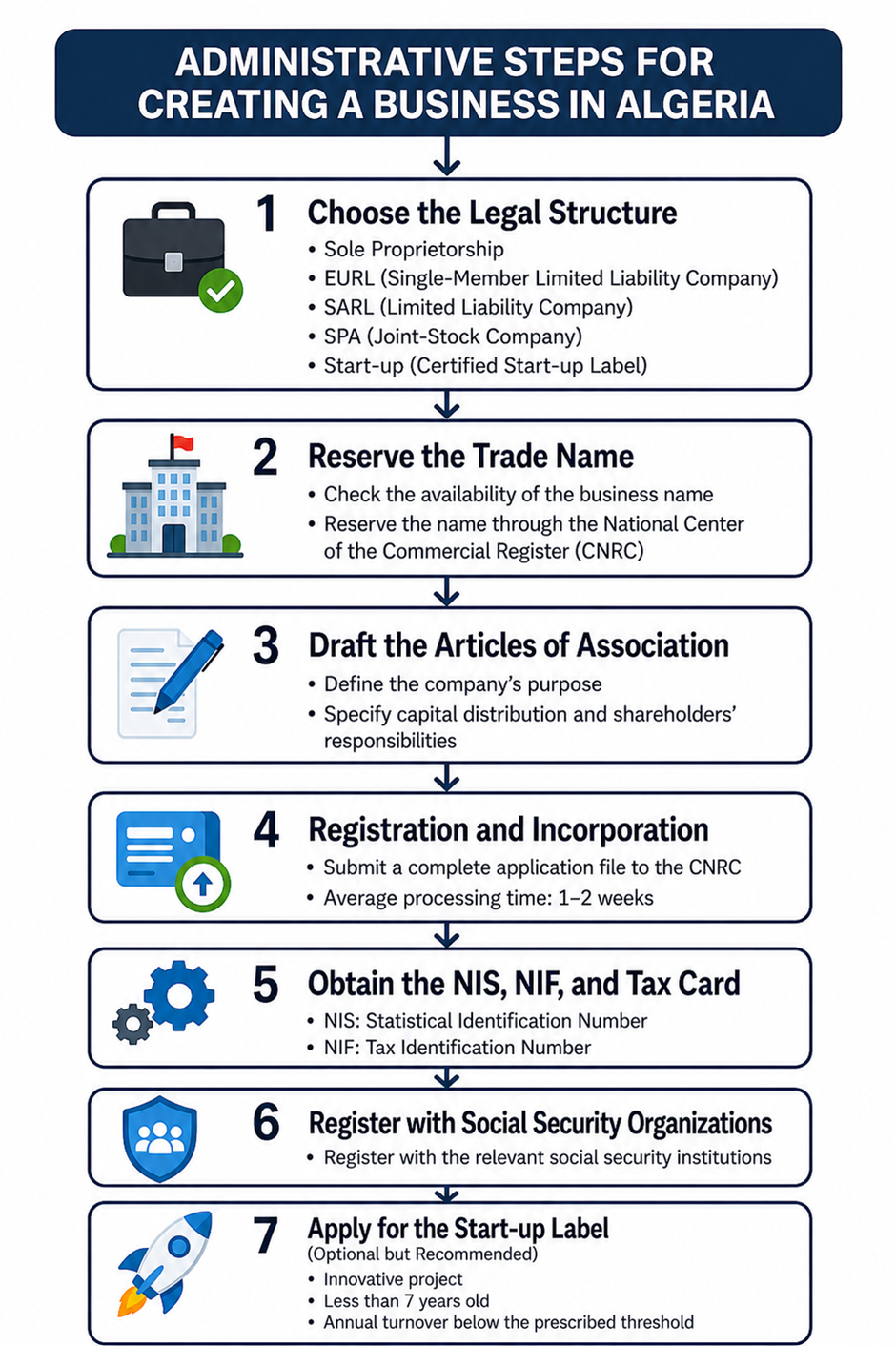
ADMINISTRATIVE STEPS FOR CREATING A BUSINESS IN ALGERIA
1. Choose the Legal Structure
- Sole Proprietorship
- EURL (Single-Member Limited Liability Company)
- SARL (Limited Liability Company)
- SPA (Joint-Stock Company)
- Start-up (Certified Start-up Label)
2. Reserve the Trade Name
- Check the availability of the business name
- Reserve the name through the National Center of the Commercial Register (CNRC)
3. Draft the Articles of Association
- Define the company's purpose
- Specify capital distribution and shareholders' responsibilities
4. Registration and Incorporation
- Submit a complete application file to the CNRC
- Average processing time: 1–2 weeks
5. Obtain the NIS, NIF, and Tax Card
- NIS: Statistical Identification Number
- NIF: Tax Identification Number
6. Register with Social Security Organizations
- Register with the relevant social security institutions
7. Apply for the Start-up Label (Optional but Recommended)
- Innovative project
- Less than 7 years old
- Annual turnover below the prescribed threshold