Aperçu des sections
-
Course : ENZYMOLOGY AND ENZYME ENGINEERING
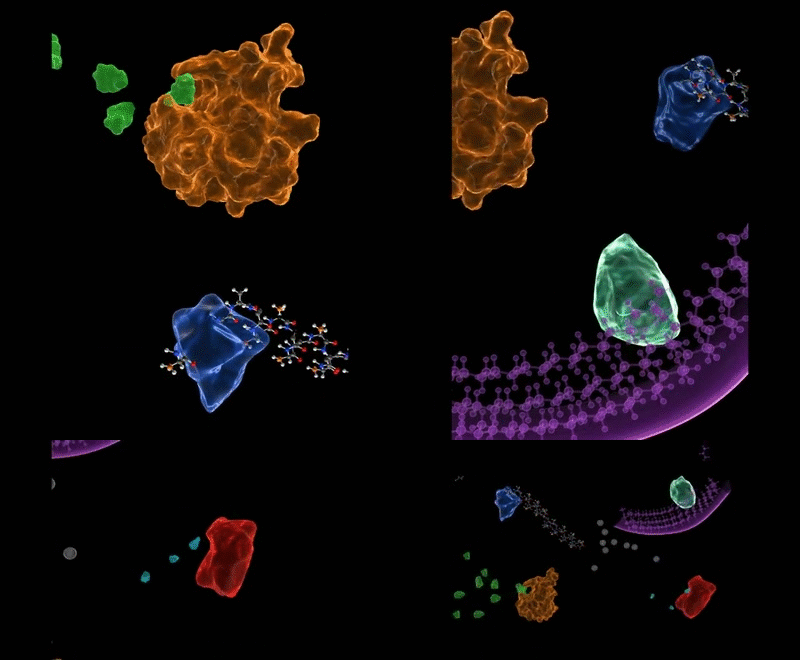
Description:
Enzyme engineering: part of enzymology, a branch of biochemistry, is the discipline devoted to studying the structural and functional properties of enzymes. "Enzyme engineering" is a branch of bioprocess engineering that deals with the exploitation of enzymes through the identification of their specificities, the conditions for their purification, their modification with the aim of improving their properties and the optimal conditions for enzymatic catalysis, and finally, large-scale production for applied purposes.
Target audience: This course in enzyme engineering is intended for Third-year students in the Bachelor's degree program in Biotechnology and Health.
The general objectives:


"Study the structure and function of enzymes,
"Know the different enzymatic applications and processes, and master enzyme kinetics in a steady state.
"Enzymes are increasingly used in industrial applications. In particular, they can be used to replace chemical products. They are produced by fermenting microorganisms (bacteria, yeasts, or fungi), which may or may not be genetically modified. These enzyme preparations are not pure; they contain numerous additives and impurities. They generally contain several enzymatic activities. The use of enzymes in various industrial fields is therefore of great interest and explains the efforts made in recent years by the scientific community in this direction. However, they remain entities that are part of the living world, and their use requires certain precautions to be taken, in particular to preserve their catalytic properties. In addition, each enzyme has its own specific characteristics, and there is no universal solution applicable to this entire class of proteins.
-