
Aperçu des sections
-
Hello Dear Students,
I will be available every week after the class to answer your questions and enrich our discussions

-
 Faculty: Sciences and Technology
Department: Process Engineering
Lectures and Tutorials: Dr. Rezgoun Sarra
Availability: In the office: Wednesday, Monday, Thursday from 11:00 AM to 12:00 PM
Target Audience: 3rd-year Bachelor's students in Process Engineering
Course Title: Mass Transfer
Credits: 4
Coefficient: 2
Duration: 15 weeks
Schedule: Sunday; Group 01: 8:00 AM - 9:30 AM (Lecture)
Room: 23
Evaluation Method: Continuous assessment 40%, Final exam 60%
Email Responses: Feel free to contact me; I will respond as soon as possible.
Contact: rezgoun.s@centre-univ-mila.dz -
The objectives of studying mass transfer are:
To understand the mechanisms of mass transfer.
To build a material balance necessary for equipment calculations.
To appreciate the formalism used to describe mass transfer.

-
Thermodynamics; Chemical Kinetics; Differential Equations

-
First, answer the prerequisite test.
-
If the student fails to achieve 50% or more in the prerequisite tests, they must consult the following references to improve their basic knowledge and enhance their background in order to better understand the rest of the course:
Book 1: Thermodynamics by Herbert B. Callen
Book 2: Thermodynamics: Course and Corrected Exercises by Michel Soustelle
-
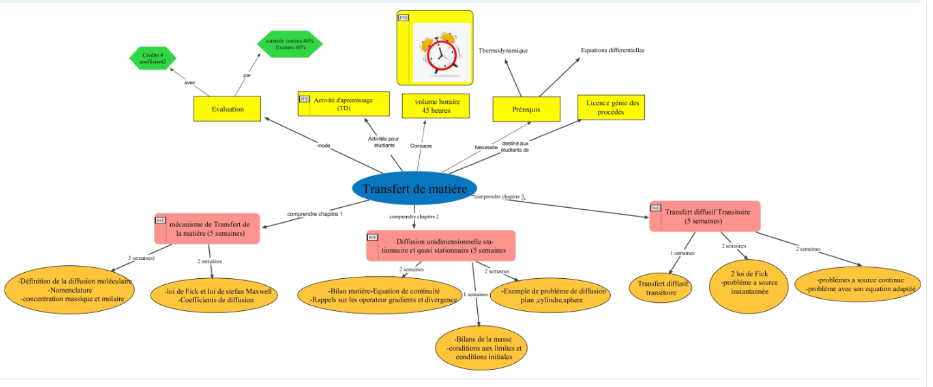
This course is divided into three chapters, as shown in the following mind map.
-
It aims to provide students with an in-depth understanding of the mechanisms through which substances move in various media. The objective is to equip students with the skills needed to model, analyze, and solve problems related to matter transfer in industrial and natural contexts.

-
Aims to equip students with the knowledge and skills necessary to analyze and solve problems related to the movement of substances in different media. It covers the fundamental principles of diffusion and convection, as well as the interactions between these processes and chemical reactions. This course is essential for understanding and modeling matter transfer in industrial and environmental applications.

-
The study of matter transfer at interfaces focuses on phase equilibria, key theories (two-film, penetration, surface renewal), and the analysis of individual and overall mass transfer coefficients. It introduces dimensional analysis using Buckingham’s π-theorem and explores dimensionless numbers (Sherwood, Reynolds, Schmidt)

-
-
-
-
-
-
-