Fundamental Laws: Newton's laws of motion
Newton's laws of motion[1], three statements describing the relations between the forces acting on a body and the motion of the body.
Principle of inertia - Newton's 1st law
In a Galilean frame of reference, if a body (material system) is isolated or pseudo-isolated its center of inertia (center of mass):
- It remains fixed if it is not moving.
- It remains in uniform rectilinear motion if it is in motion.
Then the sum of the external forces applied to the material point is zero
Fundamental relationship of dynamics - Newton's 2nd law
Newton's second law represents the fundamental principle of dynamics. In a Galilean frame of reference, the sum of the external forces applied to a system is equal to the mass times the acceleration
Principle of action and reaction - Newton's 3rd law
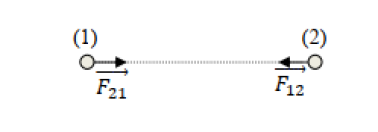
When two bodies interact, the force exerted by the first on the second is equal and opposite to the force exerted by the second on the first
Example :
Let two material points (1) and (2) interact with each other, the action exerted by (1) on (2) is equal and opposite to that exerted by (2) on (1)
These two forces are of the same nature.