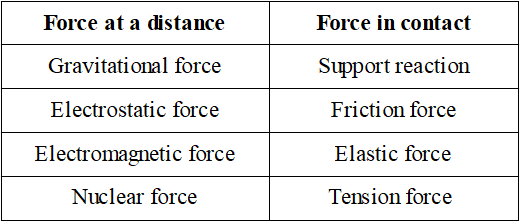
Interaction Forces
A material point is in motion because of the interactions between the particle and its environment which undergoes them; these interactions are called “forces”
Definition :
Force is defined as the amount of effort or pressure applied that causes an object to accelerate, as a result of which the direction and speed of the body changes and can cause its temporary or permanent deformation. In general, force causes a change in the motion of an object. The force is represented by a vector, such as:
Its origin: is the point of contact (force/body)
Its direction: is the direction of movement supported on the wire for the case for example of force thread tension
Its module: is the value of the force in Newton (N)
Example :
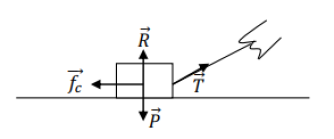
A body slides on a horizontal surface by a thread. The forces exerted on this body are: weight force, thread tension, reaction force and friction force.
The purpose of dynamics is to predict the movements of bodies subjected to forces. However, these forces act on bodies at a distance, like the gravitational force, and in contact like the reaction force.