Chapter I: Membrane Transport and Bioenergetics
الخطوط العريضة للقسم
-

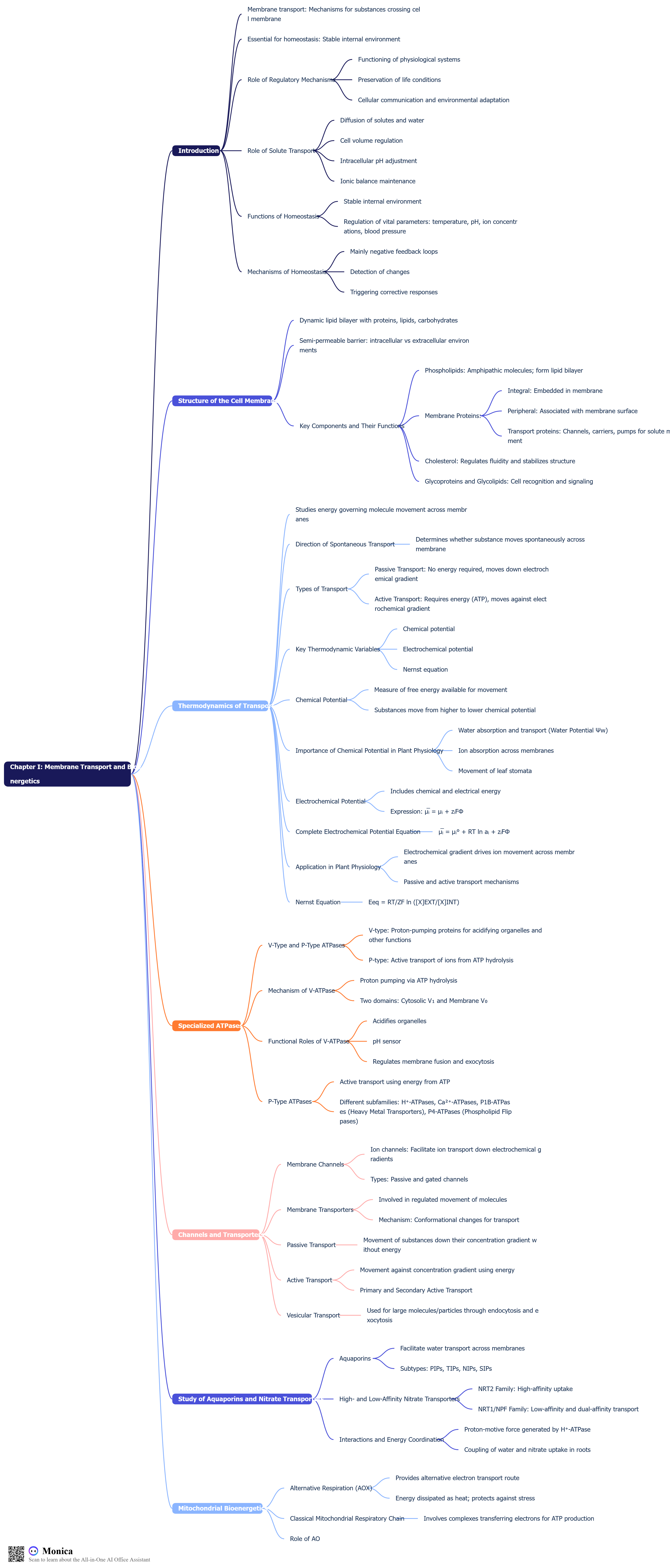
In this chapter, we will study the fundamental mechanisms of membrane transport and bioenergetics in plants, two essential processes involved in maintaining cellular homeostasis, mineral nutrition, and plant adaptation to environmental stresses. First, we will examine the structure and functional properties of biological membranes, as well as the thermodynamic principles governing the movement of water, ions, and solutes across these membranes, particularly chemical potential, electrochemical potential, and the Nernst equation.
We will then explore the different membrane transport systems, distinguishing between passive and active transport, ion channels, specific transporters, and ATP-driven pumps, particularly P-type and V-type ATPases, which play a central role in generating and maintaining electrochemical gradients. Special attention will be given to aquaporins, which regulate water transport, as well as high- and low-affinity nitrate transporters (NRT1/NPF and NRT2), which are involved in mineral nitrogen uptake and signaling.
Finally, we will investigate the mechanisms of cellular energy production and management through mitochondrial respiration, focusing on the classical respiratory chain and the alternative pathway mediated by alternative oxidase (AOX). This pathway represents an essential mechanism for regulating electron flow, limiting oxidative stress, and maintaining metabolic adaptation under unfavorable environmental conditions.
Thus, this chapter aims to provide an understanding of how plant cells coordinate membrane exchanges, energy transfers, and metabolic regulatory mechanisms to ensure proper cellular functioning, growth, and adaptation to environmental changes.