

Chapter 03: Biotechnology in Agronomy for Food Purposes
الخطوط العريضة للقسم
-
Chapter 03
3. Biotechnology in Agronomy for Food Purposes
3.1. Biotransformation and Preservation
3.1.1. Biotransformation
Fermentation is a process in which a food is transformed by microorganisms (biotransformation) in the absence of oxygen. These microorganisms are often referred to as “beneficial microbes.” For example, yogurt is the product of milk fermentation, and mold found on cheese, such as in Roquefort, is responsible for its characteristic green color and strong flavor. The process by which microorganisms and their enzymes induce these desirable changes in food is called fermentation. Humans use fermentation for three main purposes: to make food more digestible, to preserve it for longer periods, and to produce substances of interest.
Fermentation is also widely applied in the production of microbial cultures for enzymes, flavors, fragrances, food additives, and a range of other value-added products.
Microorganisms are used in the production of many products, such as:
- Beer, yogurt, Food additives
- Vaccines, antibiotics, antibodies, vitamins, amino acids
Which microorganisms are used in these processes? There are three main groups:
- Bacteria
- Yeasts
- Molds
3.1.2. Preservation
Biotechnology, as applied to food processing, relies on microbial inoculants that enhance properties such as flavor, aroma, shelf life, texture, and nutritional quality. Lactic acid bacteria are divided into two main groups based on the nature and concentration of the terminal products resulting from glucose fermentation: homofermentative and heterofermentative species. The main advantage of these bacteria lies in their ability to acidify food products. Lactic acid, as well as other organic acids (acetic acid, formic acid), are the fermentative metabolites and play a major role in food preservation by inhibiting the growth of pathogenic bacteria at low pH levels. Lactic fermentation is not only used for preserving dairy products but also allows for the preservation of various vegetables and fungi, including cabbage, beets, carrots, beans, onions, etc. This technique involves preserving vegetables by promoting the growth of lactic acid bacteria, which acidify the environment and thus inhibit the growth of undesirable organisms.
3.2. Production of Food Matrices in Bioreactors
A bioreactor, also known as a fermenter or propagator, is a device in which microorganisms (yeasts, bacteria, microscopic fungi, algae, animal and plant cells) are cultured for biomass production, metabolite production, or the bioconversion of a molecule of interest.
In the 1800s, Pasteur, Kutzing, Schwann, and Cagniard-Latour demonstrated that fermentation was caused by yeasts, which are living organisms. The term "fermentation" encompasses both aerobic and anaerobic metabolism. It involves multiplying the biomass of living microorganisms, and potentially utilizing their metabolism.
Unlike simpler systems used to grow microorganisms, such as flasks, a bioreactor allows for the control of culture conditions (temperature, pH, aeration, etc.), providing more reliable data. Laboratory models range from 0.1 to 15 liters. Models used for pilot-scale testing, aimed at industrialization, range from 20 to 1,000 liters, while those used for industrial production can exceed 1,000 cubic meters (as in ethanol production). Disposable bioreactor models have been available on the market since 1995, primarily used for volumes ranging from milliliters to several hundred liters.
In tissue engineering, the term "bioreactor" can refer to a system designed for tissue culture. Here, the goal is not to produce metabolites but to generate a complete tissue composed of cells and the extracellular matrix.
A Bioreactor consists of:
- A tank or chamber made of glass (for laboratory models) or stainless steel
- A cap, if necessary, to prevent the internal environment from being exposed to the external atmosphere
- A syringe with a catheter to inject a solution
- An agitation system featuring one or more impellers, depending on their size
- Sensors for measuring temperature (thermometer), pH (pH meter), dissolved oxygen concentration (oxygen probe), and level...
- A control system managed by a computer, allowing for the recording and regulation of all operational parameters
A fermenter is generally constructed based on the model of a bioreactor, but without an aeration system. In biotechnology, the term "fermenter" is sometimes used interchangeably with "bioreactor." It is used to distinguish between types of cultures (e.g., bacteria and yeast for fermenters, animal cells for bioreactors).
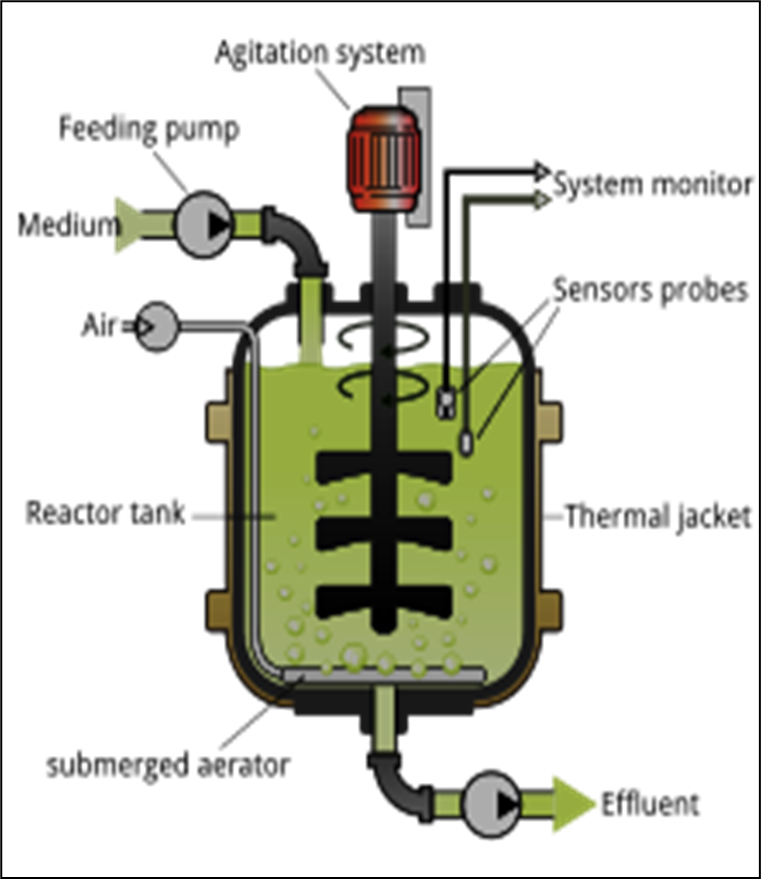
Fig: the components of a bioreactor
Components of a Bioreactor:
- Tank or chamber: Made of glass (for laboratory models) or stainless steel.
- Cap (if necessary): To prevent the exchange of air between the internal and external environments.
- Syringe with catheter: For injecting a solution.
- Agitation system: Consisting of one or more impellers, depending on their size.
- Sensors: For measuring temperature (thermometer), pH (pH meter), dissolved oxygen concentration (oxygen probe), and level…
- Control system: Managed by a computer, allowing the recording and control of all operational parameters.
Dairy Products
Milk:
Milk is composed of various substances, including fats, which are stabilized by a protein called casein, and carbohydrates, primarily in the form of lactose. The fermentation of milk allows for longer preservation and makes fermented dairy products more digestible. This transformation of milk is caused by the destabilization of casein micelles through proteolysis, resulting in coagulation.
In cheese-making, rennet technology is also used. In this case, coagulation of the casein is carried out enzymatically, notably through the action of chymosin. This coagulation leads to various consequences: it modifies the texture, flavor, and quality of the milk. The pH also decreases, which helps limit the growth of undesirable bacteria. Meanwhile, the starter cultures multiply and produce compounds responsible for the organoleptic properties of fermented dairy products.
Yogurts:
Yogurt is the product of milk fermentation by two lactic acid bacteria, Streptococcus thermophilus in symbiosis with Lactobacillus bulgaricus. The name "yogurt" is reserved for milk fermented by these two bacterial strains.
Yogurt production occurs in several stages. First, the milk is pasteurized, which eliminates pathogenic microorganisms. It is then inoculated after being cooled and maintained at a temperature of 43°C, the optimal growth temperature for lactic acid bacteria. The next step is incubation, where the milk is placed in containers for 3 hours, allowing the cultures to develop and transform the milk.
The bacteria present must still be alive at the time of yogurt consumption, which aids digestion and promotes better intestinal transit. The viable culture count at the time of sale must be greater than 107 germs/g of product.