Topic outline
-
-
Institute: Science and Technology
Department: Process Engineering (PE)
Target public: Third year PE
Fields of Specialization: Polymers
Course title: Pharmaceutical Processes
Credit: 1
Coefficient: 1
Duration: 15 weeks
Weekly timetable: 1h 30 min of course
Place of teaching: Classroom 3
Teacher: MAYOUF Imane
Contact: mayouf.i@centre-univ-mila.dz
Evaluation methods: A final exam 100%
Responses by e-mail: Do not hesitate to contact me I will respond as soon as possible.
-
1- Introducing the basic notions on therapeutic molecule synthesis, treatment, purification, and formulation;
2- Developing the manufacturing of therapeutic medicines like the synthesis of active pharmaceutical ingredients (APIs);
3- Knowledge of the methode of API synthesis;
4- Analyse the properties of the obtained ''galenic formulation'' ;
5- Analyze the synthesis processes, treatment, and purification of therapeutic molecules;
6- Evaluate the strengths and weaknesses of different galenic formulations and their impact on therapeutic efficacy.
-
In order to fully understand this course, the student must have:
- Prior knowledge of the basic concepts of general chemistry: chemical bonds, atoms, molecules, etc.
- Prior knowledge of the basic concepts of organic chemistry: nomenclatures, steriochemistry, elimination reactions, substitute reactions, solvation, preparation of molecules, etc.
- Preliminary notions on conventional extraction methods;

-
-
Hello Dear students;
I'll wait for you every week after the course to answer your questions and to enrich the discussions
-
-
This course is devided into four chapters, as represented in the mental map
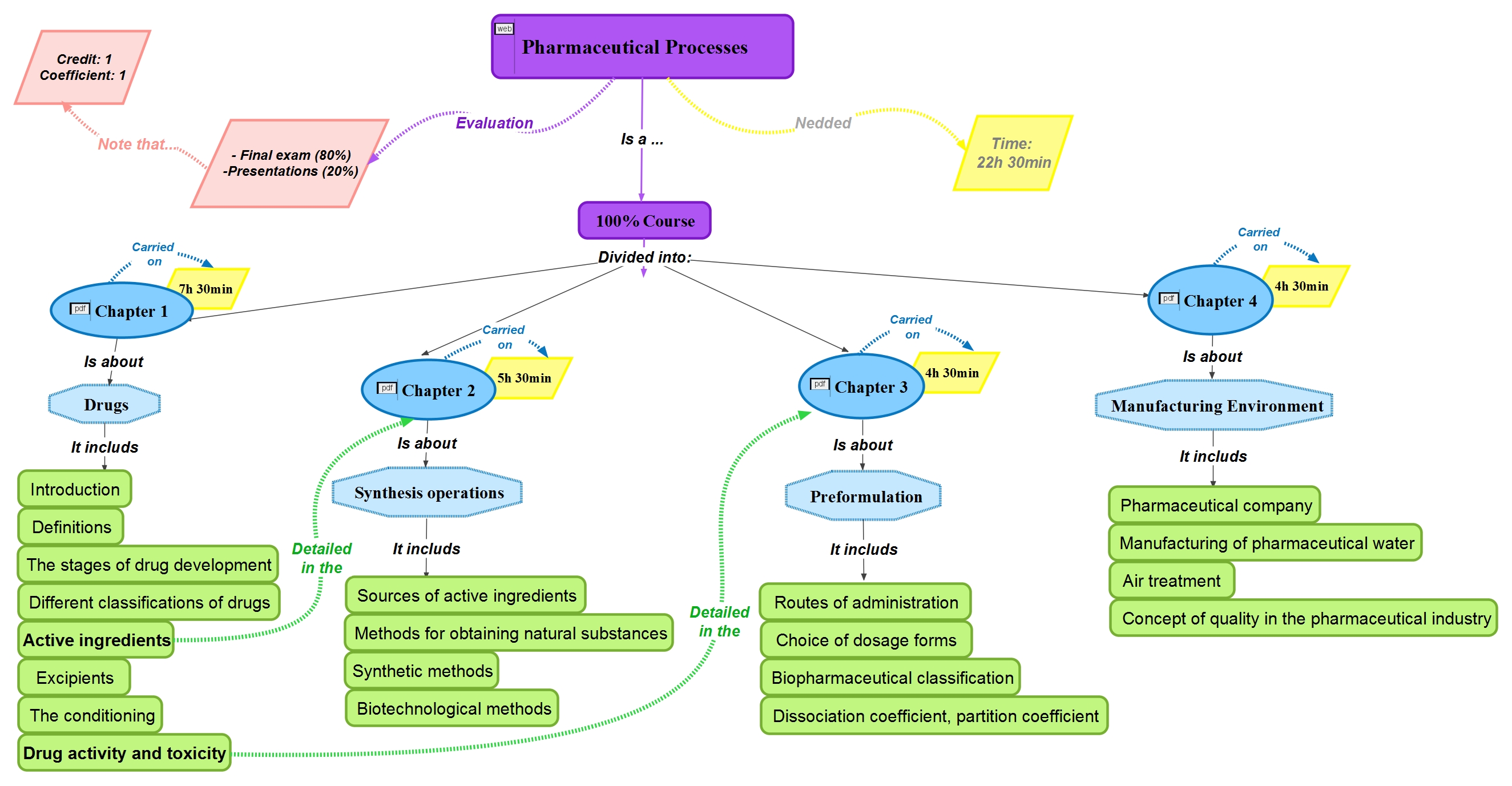
Chapter 1: The medicine
• Introduction
• Definitions
• The stages of drug development
• Different classifications of drugs
• Active ingredients
• Excipients
• The conditioning
• Drug activity and toxicity
• Become active ingredients in the body
Chapter 2: synthesis operations
• Sources of active ingredients
• Methods for obtaining natural substances
• Synthetic methods
• Biotechnological methods
Chapter 3: Preformulation
• Routes of administration
• Choice of dosage forms
• Biopharmaceutical classification (solubility, permeability)
• Dissociation coefficient, partition coefficient
Chapter 4: Manufacturing Environment
• Pharmaceutical company
• Manufacturing of pharmaceutical water
• Air treatment
• Concept of quality in the pharmaceutical industry
-
-
This chapter is based on the presentations you made
-