Concept of Work
Definition :
Mechanical work: in physics is the amount of energy required to move an object with force and distance, is a scalar quantity measured in Joule
Work of a constant force
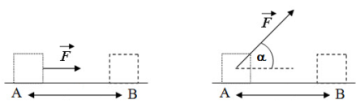
The work of a constant force when a fixed point whose effect moves from A to point B is given by scalar
α is the angle between the force vector and the vector
Note :
The work of a constant force is not related to the trajectory followed by the point of impact from A to B, i.e. the work has the same value, whether the path is straight or curved.
Work of a non-constant force
The work of a non-constant force is finding by dividing the path into elementary transitions and we call the work of the force in these transitions elementary work dW. The total work of the force on the line AB is equal to the sum of the elementary work dW.