Kepler's Laws
Kepler observed most of the planets in the solar system, taking advantage of his predecessors (Copernicus and Galilei, etc.), then he extracted the three laws which are famous in his name[1]
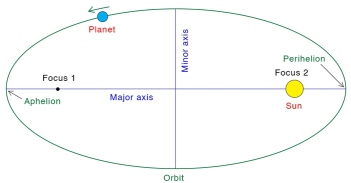
Kepler's 1st law: Law of orbits
The planets move around the sun in elliptical orbits with the sun at one of the foci.
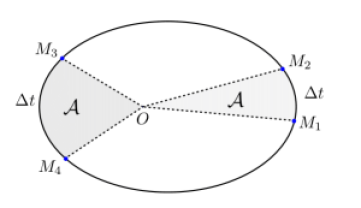
Kepler's 2nd law: Law of areas
The straight line connecting the sun and a planet covers equal areas over equal time periods
Kepler's 3rd law: law of periods
For all planetary orbits (satellites) the ratio of the square of the periods of revolution (T in s) to the cube of the semi-major axis of the orbit (a in m) is constant.